Some Moments matter more than others
Pay Attention to the Moments.
Life is filled with Moments—but not all Moments are equal.
What we mean by a Moment
A point in time when something of consequence is at stake.
It may last seconds or unfold over time. It may involve a relationship, a decision, an opportunity, a failure, a few words — or something that simply happens to us.
Some Moments affect our results. Some affect our relationships. Some help shape the person we become.
Consequence
Results
Consequence
Relationships
Consequence
Who we become

What it looks like in real life
Most Moments that matter don't announce themselves.
They arrive in ordinary sentences, in a change of tone, in a pause. The challenge is learning to notice the ones with real consequence.
01
Your wife says, “I'm fine,” but something in her voice tells you she isn't.
02
Your son or daughter starts to tell you something, then says, “Never mind.”
03
A normally engaged employee becomes unusually quiet.
04
A good friend doesn't seem like himself.
05
You are about to give someone difficult feedback, and you know how you enter the conversation could change the relationship.
06
Someone does something exceptionally well, and you can notice and encourage them — or keep moving.
None of these are emergencies. That is exactly why they are easy to miss — and why noticing them is a skill worth forming.
Some Moments are problems to solve. Some are relationships to strengthen. Some are dangers to avoid. Some are opportunities to seize. And sometimes you don't know which one you're looking at until you slow down and get curious.
Protected
Repaired
Entered with courage
Seized
Where the consequences land
Moments have consequences in different parts of life.
01
Family & relationships
Trust is built or eroded in small increments.
A spouse trying to say she is hurting. A child watching your reaction after failure. A daughter telling you something difficult.
- Repeated Moments of listening — or dismissal
- Repeated Moments of encouragement — or defensiveness
- Repeated Moments of presence — or absence
No single Moment usually decides a relationship. Accumulated Moments often do.
02
Work & financial — consequence
A Moment can carry risk. Miss it and something valuable may be lost.
A high-performing employee signals something is wrong and the leader misses it. A customer gives an early warning and nobody gets curious. A difficult performance conversation is delayed for months. Warning signs in a hiring decision are ignored. A salesperson hears the prospect's real objection and talks right past it.
- Turnover and lost customers
- Missed opportunities and damaged culture
- Avoidable costs — and real dollars
These consequences are rarely traced back to the Moment where they began. That doesn't mean they didn't begin there.
03
Formation & identity
Some Moments become part of the story we tell ourselves.
Courage. Shame. Belonging. Fear. Worth. Failure. Certain Moments do not merely pass — they get written into how a person understands who he is.
- Sometimes a Moment strengthens us
- Sometimes a Moment wounds us
- Sometimes it does both at once
Which is why it is worth paying attention not only to our own Moments, but to the Moments we create for other people.
Work & financial — opportunity
Notice it, enter it well, and something valuable may begin.
A Moment can contain risk — or opportunity. The same skill that keeps us from losing something valuable is the skill that lets us see something valuable starting.
A business Moment
The bank raised the rate. That was the Moment.
During the 2008 mortgage crisis, a bank told one of my clients it was raising his loan rate from Prime +1 to Prime +4 — four percentage points above Prime. We both recognized it: something consequential had just happened.
Instead of simply reacting, we got curious. Drawing on earlier investment-banking experience, we examined the bank itself and found it had lost more than 80% of its equity through bad loans it had made — and was trying to rebuild its position at least partly through what it charged customers.
Then we studied the client's own business more deeply. He explained openly why it was a safe credit: thousands of clients, many in relatively recession-resistant fields — medical, dental, auto repair, hair salons, food — and growing rapidly.
We prepared a presentation for another bank showing both the credit quality and the long-term relationship opportunity with a growing company. Within about 30 days he had a better banking relationship. That relationship supported the expansion and acquisition strategy that contributed to the company's roughly fivefold growth.
Notice
The bank dramatically raises the rate. Something consequential is happening.
Understand
Investigate the bank — and understand the client's business and credit story deeply.
Prepare
Package the business story so another bank can see both the credit quality and the relationship opportunity.
Act
Take the story to a better-fit banking partner.
Reflect
A stronger banking relationship supports expansion and future growth.
Sometimes the Moment that looks like a problem is actually an opportunity.
“The Moment wasn't the 5X growth. The Moment was recognizing that something consequential had just happened — and deciding to pay attention.”
Return on Time
Relationships may have the highest Return on Time of almost anything we invest in.
A few intentional minutes with an employee, a customer, a spouse, a child, a friend or someone we've just met can produce value that compounds for years. We are practiced at measuring return on money. It is worth also paying attention to the return on our time.
“Opportunity often arrives disguised as a person.”
- A new relationship
- Noticing someone's gift
- Realizing a person may be in the wrong seat — and could flourish in the right one
- Making an introduction
- Encouraging someone
- Asking one more curious question
Three Moments, 1973
Bull in the Ring
Bull in the Ring was a freshman football drill built to find out who could really hit and tackle. In 1973 we knew very little about concussions; the culture was largely about who could hit hardest. For young players it worked as a rite of passage.
I was barely 14, a late bloomer, about 125 pounds.
Your first rep wasn't Bull in the Ring. Your first rep happened at the kitchen table.

01 — The obstacle course
The Moment that nearly defined me
The freshman team ran an obstacle course to sort us into A, B and C teams. I went first, so everyone gathered around and learned from my mistakes before their turn. I did poorly and was placed on C team. I was deeply embarrassed.
“I'm C team. Maybe I'm not good enough.”
02 — The kitchen table
The Moment that reframed me
My dad picked me up after practice. I said nothing — too embarrassed to explain. He sensed something was wrong and stayed quiet until we got home.
“Michael, sit here at the kitchen table. If you don't tell me what's wrong I don't know how to help.”
I told him. He smiled, scratched his head, and reframed it: the coaches were just seeing where each kid fit and what skills he had. The team hadn't even started hitting yet. When the chance to tackle and hit came, that would be my Moment to shine.
“It's not the size of the dog in the fight, it's the size of the fight in the dog.” “When your Moment comes, put your shoulders down and lean in and give it everything you've got. Knock the guy out of his shoes.”
I felt excited, and freed from some of my fear. The world was not going to end for a 14-year-old before he had put his first foot in high school.
03 — Bull in the Ring
The Moment that tested what was already prepared
About three days later I had worked my way up to B team. A whistle blew: Bull in the Ring. We split into three circles of roughly 33. Two names were called, and those two went at each other so the coaches could see who could hit.
My name was called. Across from me stood a 15-year-old, about 200 pounds, who already had a beard.
But I knew what to do. My dad had prepared me. Shoulders down, lean in, give it everything.
I remember blackness, then blue and purple stars, then a coach lifting me off the other player: “Did you see that hit? That's how you hit. This kid starts on defense — A team.” I looked back. One of his shoes had come off.
Looking back as an adult
At 14, I experienced that as triumph. Decades later I also see how much physical and psychological weight was resting on one young boy in a single rite-of-passage Moment in 1973 — before concussion risk was understood the way it is today. It could have affected me very differently.
We do not always understand a Moment's significance while it is happening. And not every Moment can be scheduled or rehearsed. Some simply arrive.
The Moment that mattered most was the quiet one. My father noticed his discouraged son, listened, made it safe to talk, reframed what had happened, restored hope — and prepared me for a Moment neither of us knew was three days away.
Discussion creates perspective. Practice creates readiness. Don't let the Moment that matters be your first rep.
Return on Time
My father invested a few intentional minutes with a discouraged boy. Those minutes shaped how I entered another Moment three days later — and I'm still telling the story more than five decades later. Relationships compound.
The critical distinction
Recognizing the Moment is not enough.
Under pressure we usually don't rise to our intentions. We fall back on our defaults — patterns already formed in us long before this Moment arrived.
Pressure exposes
- Defensiveness
- Avoidance
- Anger
- Fixing
- Controlling
- Shutting down
Preparation forms
- Patience
- Curiosity
- Courage
- Listening
- Love
Discussion creates perspective. Practice creates readiness.
The formation pathway
How preparation becomes part of who we are
01
Notice
See that something with real consequence is in front of you.
02
Understand
Slow down enough to grasp what is actually at stake.
03
Prepare
Decide who you want to be before you are in it.
04
Practice
Rehearse it honestly, out loud, with men who tell the truth.
05
Act
Enter the Moment on purpose rather than by reflex.
06
Reflect
Come back and look honestly at how it went.
07
Repeat
Repetition is how preparation becomes formation.
“Don't let the Moment that matters be your first rep.”
And the nuance matters: not every Moment can be anticipated or practiced. Some arrive without warning. What we have been formed into beforehand affects what we bring into the Moments we never see coming.

One ecosystem
How Moments connect to everything else
The Five Entrustments
tell me WHAT matters.
Moments
are WHERE what matters gets lived.
Intentional Brotherhood
helps me PREPARE.
Practice
helps form WHO I become.
Inner Person → Five Entrustments → Intentional Brotherhood → Moments → Perspective & Practice in the Room → Formation → a stronger outer life → fruit and multiplication.
Go deeper
Want to understand Moments more deeply?
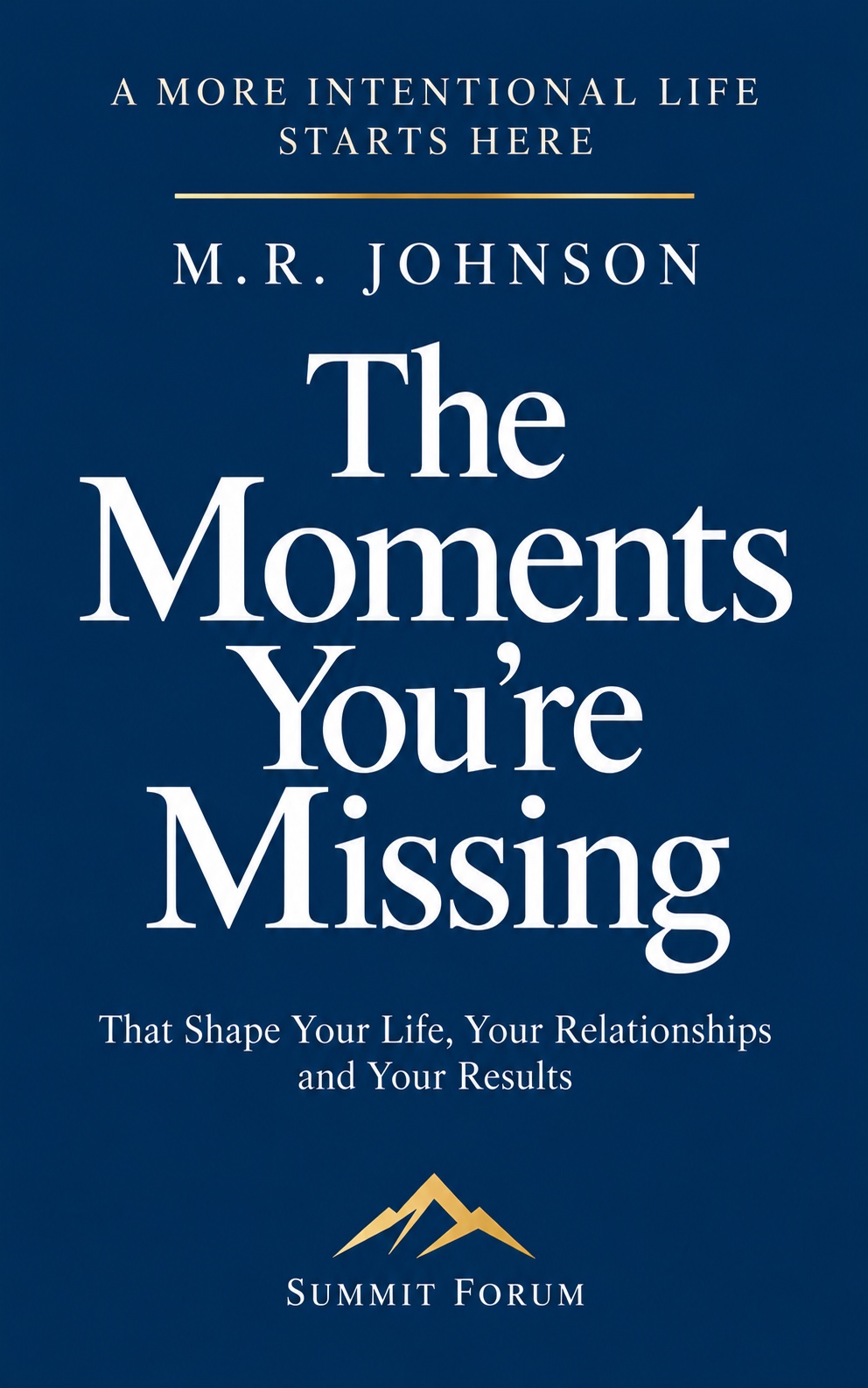
The Moments You're MISSING — That Shape Your Life, Your Relationships and Your Results
This page introduces Moments. The book goes further: what makes a Moment consequential, how Moments shape your life, your relationships and your results, and how to become more intentional about recognizing and entering them.
- What a consequential Moment actually is
- How ordinary Moments shape relationships and results
- Why noticing alone is not enough
- How to prepare for the Moments you can see coming
The book is available now on Amazon in paperback and Kindle.
Where to go next
Start by paying attention to one Moment this week.
Notice it. Slow down. Ask what is actually at stake. Then decide who you want to be when you enter it. If you would like company for that work, we would be glad to tell you more.
Next